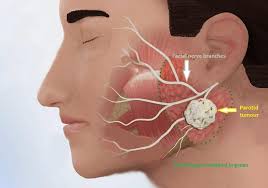
Salivary Gland Cancer is a rare type of cancer that develops in the salivary glands, which are responsible for producing saliva to aid in digestion and maintain oral health. The most commonly affected gland is the parotid gland, located in front of the ear, where parotid tumours can develop. Most parotid tumours are benign (non-cancerous), but some may be malignant and require prompt medical attention. Risk factors include prior radiation exposure, certain genetic factors, and long-term environmental exposures, although in many cases the exact cause remains unknown. Common symptoms include a painless swelling or lump near the jaw, ear, or cheek, facial weakness or numbness, difficulty in opening the mouth, and sometimes pain in the affected area. In advanced cases, there may be difficulty swallowing or noticeable facial asymmetry. Diagnosis involves clinical examination, imaging tests such as ultrasound, CT scan, or MRI, and fine needle aspiration cytology (FNAC) or biopsy to determine whether the tumour is benign or malignant. Treatment depends on the type and stage of the tumour. Surgery is the primary treatment for most parotid tumours, often followed by radiation therapy in malignant cases. Special care is taken to preserve the facial nerve during surgery. Early detection and proper management significantly improve outcomes and help maintain facial function and quality of life. Regular checkups and timely evaluation of any persistent swelling are highly recommended.